Thursday, November 19, 2020

Theory Another Student Talked About

     I know a little bit about a lot of the theories each of the groups talked about, and all of them are worth talking about.  They're kinda scary, in a way, how they all work together to shape our minds, especially because they spread so far now.  But the one I want to talk about is "Total Information Awareness."

    Total Information Awareness is a concept based on predictive policing.  The idea is that the government can gather information about a person and predict whether they are likely to commit a crime.  They wouldn't just gather bits of information, either; they'd get minute details about every aspect of your life.  That's a pretty scary thought.  The idea came after the events of 9/11, so the government could scout for potential terrorists.  It was defunded by Congress after heavy backlash.

    I completely agree with this backlash.  It invades more than just our privacy.  It also invades our other rights, like free will and the promise of a free and fair trial.  If government decides you are likely to commit a crime, and if they can punish you before you've even committed a crime, then you aren't being given the right to your free will.  Free will rests upon the idea that all actions have consequences.  If I choose to do something that's good, the consequences will be good.  Conversely, if I choose to do something bad, the consequences will be bad.  But consequences can only happen after the action.  Otherwise, it's a perversion of justice.  It's also illegal in the United States to be punished for a crime you haven't committed, even if you were going to commit the crime but haven't done so yet.

    Another reason I wanted to talk about this theory is because it reminded me of a movie.  This idea is the exact plot of Captain America: Winter Soldier.  The premise is that the government agency S.H.I.E.L.D. is setting up a program that tracks everyone all the time and predicts who is likely to commit a crime.  Then, based on that information, S.H.I.E.L.D. can intervene before the crime is committed.  Captain America is against this because it takes away people's freedom and turns America into an authoritarian regime.

    It's good that the United States ended this program, but many aspects of it still exist.  Now, we willingly put ourselves on the internet for the world to see.  World governments have ways to extract that data, and social media platforms sometimes give it to people for a price.  It's really corrupt, and we've become so dependent on the internet that we've fallen into an inescapable trap.

Here's one of the sources they used:

https://www.aclu.org/other/qa-pentagons-total-information-awareness-program


Online Privacy

     I'll start by saying one thing:  I'm very glad I never got into social media.  I feel like I really dodged a bullet there.  I'll say another thing:  I'm not letting my future kids get into social media.  I'll get them into video games like my dad did for me.

    In all seriousness, though, it's pretty scary how the world has gotten.  We as humans have become so reliant on technology.  It's scary how quickly we've become so entirely dependent on the internet.  I forget where this quote is from, but I think the quote "What one generation does in moderation, the next one does in excess," applies here.  It only took one generation for humanity to become entirely dependent on technology.  

    Hearing about how we have practically no privacy online is shocking to hear about, but it doesn't entirely surprise me.  I've heard stories about people being doxxed or having their identities stolen before.  I've heard people say, "Be careful what you put online, because once it's there, it'll never come off."  But to hear specifics of how widespread this is is eye-opening.

    To go back to my first point, I never really got into social media.  I only made a Twitter account to participate in a giveaway Nintendo was doing (which I didn't win, big surprise there), and I never used it again.  After this class, I deleted my account.  It won't be missed.  I also have a Facebook account, but, again, I never use it.  I only use it to send "Happy Birthday" messages to friends, and even then, I don't do it for every friend (Also, for the record, I'm not one of those people who has 5oo friends on Facebook; it's just my family and some friends from school or church).  I'm glad that I haven't really put that much of myself out there online.  It's like a toothpaste tube: once it's out there, there's no undoing that.

https://www.ted.com/talks/juan_enriquez_your_online_life_permanent_as_a_tattoo/up-next?language=en


Discord experiences outage as some servers go dark - Polygon 

Discord is the only real "social media" site I use (I don't count YouTube as social media, but I use that, too).  It was made to be a social media site for people who play video games to connect.  I only use it to talk with friends I know in real life.

Tuesday, October 20, 2020

Diffusion Theory - Video Games

     Because I am both an avid video game player and a game design major, I am very invested in video games.  Thus, I would like to talk about the innovation of video games through the lens of the Diffusion Theory.  

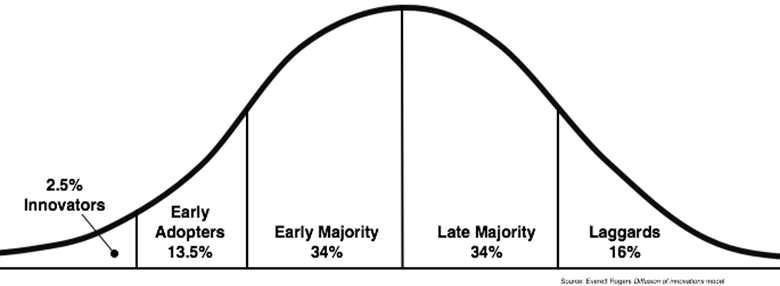
    The first section in the Diffusion theory is the Pioneers.  These are the people who made the first video games back around the mid-to-late 1970s.  These early games were either really simple, like Pong, or were entirely text-based with branching paths (branching "choose your own adventure" style games are debatable whether they count as video games).  The Early Adopters phase would be around the early 80s, when arcades started to become common.  This was still a little bit before and even into the early days when video game consoles could be bought for personal use.  By the mid 80s, a lot of families owned video game consoles or regularly went to the arcade to play, starting the Early Majority phase.  Video games were still fairly niche and were considered "nerdy" and "just a fad."  Well, the nerdy part is still kinda true, but now, video games have certainly proven that they aren't just a fad.  

    I suppose I would say that around the turn of the century is when the Late Adopters section begins.  This is when the people who grew up in the 80s started having their own children and getting games for them and even playing with them.  This is the case for me, as I was born in 1998, and my dad got me into video games from an early age.  We still play some games together, though I've started playing more single-player games, and he is more and more busy with work and thus doesn't have as much time to play with my brothers and me.  Going into the current era, the video game industry is booming, and there are hardly any Laggards who have never and refuse to play video games.  Of course, there are still some, such as those who can't afford them or who stick with the belief that they are bad for you.

    Overall, I think the invention and innovation of video games is a good thing, but I can see that there are some downsides to them.  For one, video games (as well as TV and other electronic media) have contributed to a general lowering of attention span among young people.  There is also the argument that staring at screens has negative effects on your health, namely eye damage and possibly mental health.  Despite that (though I am biased), I think that video games have more positives than negatives.  I think that video games have great artistic value, and they can be used to convey ideas and messages.  They are also a good passtime and method of entertainment, and they can be used to make new friends.  Not all video games are mindless, either.  Some have rich stories and advanced concepts, and some are active and serve as a way to get exercise or improve your reaction time.

Diffusion of Innovation Theory

Here is the article I got this picture from:

https://sphweb.bumc.bu.edu/otlt/MPH-Modules/SB/BehavioralChangeTheories/BehavioralChangeTheories4.html

Monday, October 19, 2020

Technology Another Student Talked About

     I forget who it was, but another student talked about the invention of motion picture.  This invention ties in pretty well with the technology I talked about, the TV.  Of course, before the television was invented, the motion picture was.   

    The student talked about the early idea of a moving picture being the flip book.  Flip books are books in which every page has an image, and when you flip through the pages really fast, it looks like one moving image.  The most famous example of this concept is the "Galloping Horse," which contains 16 consecutive pictures and was shown on a "sequential image projector."

    According to the student, the "kinetograph" was invented in 1890.  The kinetograph was able to show images in rapid succession along the style of a flip book to simulate motion.  The first motion picture shown to the public was shown in 1893.  Another progression in motion picture technology was the "cinematographe," which was a projector that could show 16 frames per second.  For reference, most modern video games play at 60 frames per second.

    The continued development of motion pictures led to silent films, talkies, and eventually color films.  The invention of the television was also a huge development for motion pictures because it allowed families to have their own sources of motion pictures in their own houses. 

 Here is one of the sources the group used:
https://www.britannica.com/art/history-of-the-motion-picture

Animal Locomotion: Plate 626 (Galloping Horse) – 20x200 

"Galloping Horse"

Tuesday, October 13, 2020

EOTO - Each One Teach One - Television

      For my part of the EOTO presentation, I researched and talked about the history of the television.  I started with the invention of the first television, which was actually harder than in may sound.  For starters, there is a difference between a mechanical television and an electronic television.  The mechanical television came first, but it was incredibly impractical.  It was huge, had a super tiny screen, terrible quality, and wasn't commercially viable.  But it was a start.  It led to the introduction of the electronic TV, which is considered where the invention of the TV really came from.

     The second thing that made it hard to nail down was that multiple people argued (in and out of court) over who actually first invented it.  I found that in 1922, Charles Jenkins send the first still image over radio waves.  Then, in 1926, John Baird sent the first live transmission, using a device he called a "televisor."  The next year, Philo Farnsworth patented the first electronic TV set, which he called the "image dissector."  Then, in 1929, Vladimir Zworykin made improvements to this system.  Because all these people were working on the same thing at the same time in many different places, it was hard to tell who really did it first.  Today, Farnsworth is often credited with the invention of the television.

     There have been many improvements since then, such as sound, color, and quality.  I found that the color TV was invented sometime between 1946 and 1950, but I couldn't find a specific date.  The first successful color broadcast was in 1953.  Now, there are so many different TV companies and innovators making tons of different kinds of TVs.

     Next, I went over the top eight TV manufacturers in the world.  Only one of the eight is from the United States, with all the rest being from Asian countries.  Samsung was started in 1969 in South Korea, LG started in 1958 also in South Korea, Sony and Panasonic were started in 1946 and 1918, respectively, in Japan, Hisense (1969), TCL (1981), and Skyworth (1988) are Chinese manufacturers, and Vizio is the only American one and is also the most recent one, having started in 2002.

     Lastly, I went over some of the pros and cons of the television.  For the pros, I noted that TV is a great form of entertainment, and that it is a great repository for art.  TV shows, dramas, plays, and musicals are all art forms that have been enhanced by the invention of the TV.  It also provides a source of mass communication.  Ideas and stories can be shared to myriads of people, as well as news.  As for the cons, I said that the rise of television has led to a decline in attention span.  It also poses possible risk of eye damage.  Finally, there is the potential for inappropriate material to be spread through TV, and there are many rules and regulations put in place for that. 

https://www.thoughtco.com/color-television-history-4070934 

https://wonderopolis.org/wonder/Who-Invented-the-First-TV 

https://blog.technavio.com/blog/largest-tv-manufacturers-by-market-share


 I like this picture because it shows a lot of different video game consoles that can be played on the TV, and, in case you didn't know, I'm a huge fan of video games.

Eight Values

     I would like to talk about the mainstream media and their relationship with the idea of "Participation in Self-Government" and with the truth.  In the past, before internet was widely available, people mostly relied on the news to get information on what's happening outside their communities and around the world.  Before news on TV, there were newspapers.  News organizations had a vested interest in telling the truth, as they still should.

     Nowadays, however, because of the creation of the internet and forwarded by the invention of the smart phone, regular people can research news topics on their own very easily and don't have to rely solely on what they hear on the news.  As a matter of principle and to help the average citizen be able to effectively participate in self-government, we need to know the truth.

    This is where I think the media has run into problems.  Americans' trust in the media is at an all-time low, and more and more individuals are taking it upon themselves to fact-check the news and deliver it on their own, such as on YouTube channels or in podcasts.  And this lack of trust in the media is not undue, nor is it particularly surprising.  

     To the point of it being fair to distrust the mainstream media, they have been found time and time again releasing faulty, misleading, or outright false reports.  This has been especially exacerbated with the 2016 Presidential election.  It's no surprise that the media has a political bias; everyone has a worldview.  But before President Trump took office, the media did a better job hiding these biases.  Now, however, ranging from their relentless pushing of the Russian collusion narrative for 3.5 years (which turned out to be a total hoax) to them claiming that the BLM riots are no more than "mostly peaceful protests" (all while erroneously claiming that most political violence stems from the right) to them saying over and over that Trump refuses to condemn white supremacy (despite him doing so over and over again), the media has been shown to push (whether through ignorance, incompetency, or outright malice) lies.  

      The thing is, the media is perfectly able to categorize reports stemming from their political opinions as such while categorizing reports that consist solely of the facts under "news," but they've blurred the line between them so much that they are often found reporting nonsensical opinions as fact.  And as the old adage goes, "If you say something loud enough and often enough, people will eventually accept it as true."

     I don't want to assign motive to anyone, and what I can attribute to ignorance or neglect I would rather not attribute to malice, but given that such an overwhelming majority of "mistakes" the media makes in reporting favor one political side and hardly ever favor the other, there's some point where it's not just an "honest mistake."  And the thing that makes me the most angry about this is that when the media jumps ahead, doesn't wait for the facts (or outright ignored them), reports a false story, and are then called out on it, their correction doesn't seem to get 1/100th of the attention.  People have already heard the story, drawn their conclusions, and dialed up their outrage to the point where the truth hardly matters anymore.  From stories like the Jussie Smolett case to the Covington Catholic case to even George Floyd, Jacob Blake, and Breonna Taylor, the media has spread lies, mistruths, and propaganda for too long.

     This is the big problem I have with the media.  As a conservative, I believe that the government should stay out of as much as they can, but on the other hand, I'm sick and tired of the media getting away with this.  It goes against my belief of the role of government, and I know that if this were to happen, it would be just a matter of time before this sword is wielded against me, but I think the media needs to be held accountable for their actions.  If citizens aren't given the truth, how are they supposed to participate in self-government?  How are we supposed to pursue better lives for ourselves and individuals, members of a community, or even as humans if we can't tell what's true or false?

Here is an article reporting on the false coverage of the Jussie Smollett story and the fact that Smollett was prosecuted for making a false police report:

https://www.dailywire.com/news/breaking-jussie-smollett-indicted-by-special-prosecutor-in-chicago

I can't say for certain completely how accurate this graph is, but it seems pretty accurate to me:

AllSides.com Calls out Media Bias from Both Sides, Promoting Democratic  Dialogue and Free Speech | KSFR


Tuesday, September 22, 2020

Supreme Court - Blog Post 2

      The Supreme Court is equal to the Legislative and the Executive branches, and has checks and balances with them.  It was established to rule on the constitutionality of cases and to be non-partisan.  Despite this idea being good on paper, in reality it doesn't always live up to that.  Of course, justices are allowed and assumed to have their political leanings, but they aren't supposed to let those leanings interfere on their judicial decisions, but let strictly the Constitution influence them.

     Nowadays, the Supreme Court has unfortunately become political.  Justices appointed by Republican Presidents are hated by the left, and justices appointed by Democrats are hated on the right.  The President is supposed to appoint justices based on who is the most qualified for the position, but the temptation to appoint someone primarily because they agree with you is often too strong.

     I know I'm late on this post; I read the info, but I forgot to actually write the post.  But I am going to take the opportunity I have of writing this now to mention the news from over the weekend that has brought a huge amount of attention to the Supreme Court: the death of Ruth Bader Ginsburg.  Because her passing happened so close to an election (and a particularly intense election at that), the idea of whether or not Trump should be allowed to appoint a replacement before the election is being hotly debated.  However, I fear that this debate is less about the actual principle of the matter -- whether it is ethical for a President who is potentially almost out the door to push someone through before the time limit -- and more about the politics of the matter.  Because justices are often appointed by the President and/or rejected by the Senate based solely on their politics and not their qualifications, Democrats are expectedly against Trump appointing someone, while Republicans are expectedly for it.

     Personally, I think Trump has every right to appoint a new justice, even if he is at risk of losing the Presidency, because of two reasons.  For one, it's not like this is the first time in history this has happened.  Democrats have rammed a new justice through on their way out the door, just as Republicans have done it before.  And second, it's not like Trump isn't President anymore just because an election is going on.  We didn't elect him to a 95% term.  We elected him to a full 4-year term.  Constitutionally (which, again, is what the Supreme Court is supposed to be all about), he has every right to appoint a justice to replace Justice Ginsburg, even during an election season. 

Here is an article from The Daily Wire talking about Amy Coney Barrett's nomination and whether it's okay for her to be confirmed:

 https://www.dailywire.com/news/mcconnell-pushing-forward-relentlessly-confirming-judges


What you need to know about Amy Coney Barrett - POLITICO

Anti-War News

     I could say that the reason we don't hear about these issues of foreign intervention in the mainstream media is because they are trying to push an agenda.  I could say that I think they want these wars to go on for whatever reason, but I'm not going to.  While I am not one to trust the mainstream media very much, I don't want to be conspiratorial and assume bad motive.  There might be some of that, but there might not be.  I think the main reasons behind us not hearing about foreign affairs such as wars and violence on the part of the US are twofold.

     For one, I think the media doesn't want to report on this stuff because they are focused on making money, and reporting on this information might not be very lucrative in their view.  The other part, which ties into it, is that they try to report on things that an average Joe will understand.  I can't speak for anyone but myself, but I honestly don't understand foreign policy very much, even though I do pay attention to politics.  Even if I'm told what happens in the Middle East, I'm not going to understand it very well unless it's carefully explained to me.  And the mainstream media isn't really the place for that.  They're focused on boiled down, quick explanations of things, and foreign policy is too deep for that.  At least, that's how I see it.  I could be wrong.

     I think that the reason we have to find obscure websites for this kind of information is because it's kind of a niche topic.  Unless you're already interested in foreign policy, it's not really something you'll be able to readily understand if you come across it.  I think that's why websites like antiwar.com are obscure.  They're the kind of topics that need to be sought out rather than stumbled upon.

https://www.antiwar.com/

https://www.theamericanconservative.com/web-categories/realism-restraint/

The Pictures that Defined World War II - HISTORY

Monday, September 7, 2020

Week 4 Reading Response

     Black Lives Matter has been a very hot topic the past couple of months.  The phrase "black lives matter" has become what conservative podcast host Ben Shapiro has called "semantically overloaded."  This means that the phrase has too many different meanings, and that agreeing with one definition doesn't necessarily mean you agree with every definition.  In the case of Black Lives Matter, conservatives argue that the basic statement that black lives have value is uncontroversial, but the movement of the title "Black Lives Matter" is a bad movement.
     Part of what they mean when they argue against the movement is their tactics.  The movement BLM has routinely participated in anti-white and anti-cop rhetoric, as well as a lot of physical violence and aggression toward those groups.  Because of all this damage BLM has caused and advocated, certain areas are beginning to place restrictions to curb their violence and destruction.  But BLM and their supporters see this as discriminatory and as violations of their First Amendment rights.
     The problem with their claim that their rights are being violated is that the First Amendment protects citizens' rights "peaceably to assemble."  Given the amount of violent behavior BLM consistently participates in, putting limitations on their assembly definitionally does not infringe on their First Amendment rights.  One note the article makes is that "Black Lives Matter-Los Angeles contends that these curfew orders limit their ability to engage in peaceful political protests," but they often fail to meet the "peaceable" requirement to claim this protection.
      Another thing the article mentions is that the lawsuit in question regarding a curfew in San Bernadino and Los Angeles County, CA gives exception to travel during curfew to and from religious meetings.  Those filing the lawsuit claim that this exception is equivalent to the government advancing religion, which goes against the clause in the First Amendment that says "Congress shall make no law respecting an establishment of religion."  But this, too, is faulty reasoning by BLM and its supporters.  For one, this exception applies to religious practice in general, not favoring any particular religion.  And also, they are ignoring the very next clause, which says "...or prohibiting the free exercise thereof" (referring, of course, to religion).  On the contrary, if the curfew in question didn't have such an exception, there could be an argument to be made that it infringed on this clause of the First Amendment.
     The way I see it, BLM has no grounds to legally dispute this curfew, considering they are not a peaceful assembly, and thus, their exercises do not fall under the First Amendment's protection.

 https://www.mtsu.edu/first-amendment/post/708/black-lives-matter-others-challenge-curfew-orders-on-first-amendment-grounds

 Respecting the 1st Amendment | @theU

Tuesday, September 1, 2020

What 5 Media Sources Do I Use?

What 5 Media Sources Do I Use?:

1. FOX News (https://www.foxnews.com/) - FOX News is the main TV news channel I watch.  I honestly don't watch very much TV anymore; I usually watch YouTube.  But I occasionally watch FOX to see the headlines and what they're talking about.  I like FOX not necessarily because they're conservative (though that's part of it), but because they are one of, if not the only, mainstream news outlet that isn't on the left.  It's nice to see a news channel go against the grain.  That being said, I won't hide the fact that I'm a conservative, so I also like them because they're on the same side of the aisle as me.

Fox News - Breaking News Updates | Latest News Headlines | Photos & News  Videos

2. CNN (https://www.cnn.com/) - Similarly to FOX News, I don't watch them too often because I just don't watch TV that much, but I like to turn them on occasionally to see what they have to say.  Like I mentioned before, I'm a conservative, so I strongly disagree with much of what CNN says, but I think it's important to hear what people who you disagree with have to say.  And I don't care if CNN claims to be objective; they are far from objective.

CNN logo, designed in 48 hours | Logo Design Love

3. The Daily Wire (https://www.dailywire.com/) - The Daily Wire is a conservative news outlet that operates mostly on YouTube and on their own website.  It hosts conservative talk radio/podcast hosts such as Ben Shapiro, Andrew Klavan, and Michael Knowles.  I mostly listen to Ben Shapiro's daily podcast, as I think he does a very good job explaining the details of different news stories.  He doesn't hide his conservative biases, but he does his best to give his listeners/readers as much info as he can.
https://www.youtube.com/channel/UCaeO5vkdj5xOQHp4UmIN6dw

WATCH: Ben Shapiro Eviscerates Abortion Argument PART 2 | Daily Wire

4. Louder With Crowder (https://www.louderwithcrowder.com/) - Louder With Crowder is the podcast owned and hosted by Steven Crowder.  Crowder labels himself as a comedian, and his show is intended to be a conservative alternative to standard late night talk shows like those hosted by Jimmy Kimmel, Trevor Noah, and Samantha Bee.  He talks about current news stories, often making jokes about them.  I don't watch him quite as much as Ben Shapiro, but I like to see his take on issues as well.
https://www.youtube.com/user/StevenCrowder

LOUDER WITH CROWDER STORE – The Louder with Crowder Shop

5. The Beauty and the Beta (https://www.mattchristiansenmedia.com/) - This is another podcast hosted by a smaller YouTube channel owned by Matt Christiansen.  Christiansen voted down-the-line Democrat his whole adult life up until 2016, but he started to become wary of the left's changes to more and more radical positions.  He is a staunch defender of the Constitution and especially of the 1st Amendment.  Every few days, he uploads 10-15 minute videos covering specific news stories, and every Sunday he hosts his podcast with a friend, where he discusses all of the week's news in greater depth.  I really respect his commitment to his principles, and I like to see the two's back-and-forth about topics.
https://www.youtube.com/user/LibraryOfCODRage

 Matt Christiansen - YouTube